Ingredient Splitting: The 'Meat First' Myth on Pet Food Labels
Discover how ingredient splitting artificially boosts meat to the top of pet food labels and learn the expert tricks to uncover the true contents of your dog's bowl.
If you have ever stood in the pet food aisle of a Tesco or Sainsbury’s, squinting at the fine print on a bag of kibble, you have likely been told to look for meat as the first ingredient. However, savvy manufacturers often employ a technique known as ingredient splitting to ensure that meat appears at the top of the list, even when it is not the primary component of the diet. This marketing sleight of hand can lead well-meaning owners to believe they are purchasing a high-protein, meat-rich meal when, in reality, the bag may be filled primarily with carbohydrates like maize or peas. Understanding how to navigate these labels is essential for any British pet owner looking to provide the best nutrition for their companion while avoiding the 'meat first' myth.
What is Ingredient Splitting and How Does it Work?
Ingredient splitting is the practice of taking a single, lower-quality ingredient and dividing it into several smaller sub-categories on the ingredients list. Because UK labelling regulations require ingredients to be listed in descending order by weight, splitting a bulky filler like maize into 'maize flour', 'maize gluten', and 'maize meal' allows each individual portion to weigh less than the primary meat source. Consequently, the meat—often weighed before dehydration—is propelled to the coveted first spot on the label.
This tactic is remarkably effective because most consumers only scan the first three items on a list. By the time you reach the fourth or fifth ingredient, your brain has already categorised the food as 'high quality' because of the initial meat entry. In reality, if you were to recombine those three maize components, their total weight would frequently far exceed the weight of the chicken or beef listed at the start. It is a legal loophole that relies on the consumer's lack of technical knowledge regarding food processing.
Manufacturers divide fillers into multiple names to keep meat at the top of the weight-descending list.
The Recombination Rule: Identifying Hidden Fillers
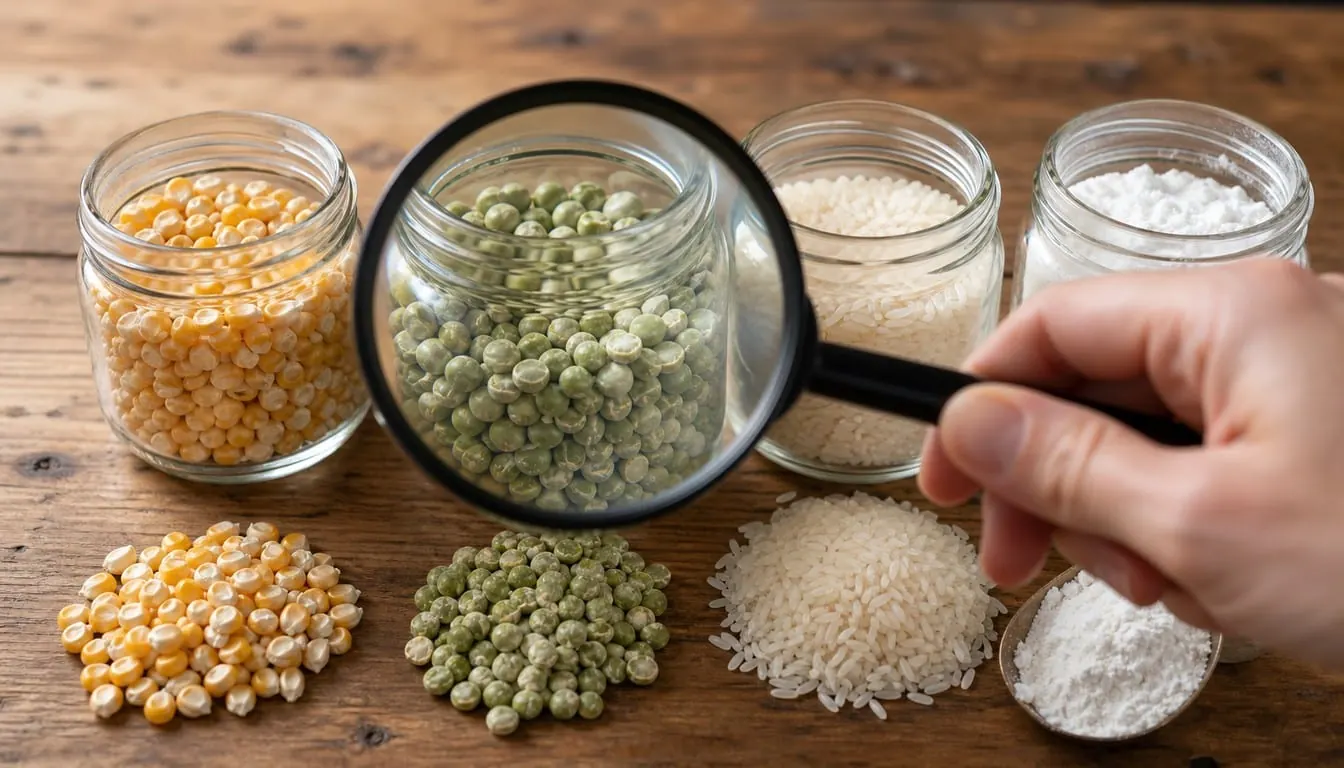
The recombination rule means mentally adding together every version of the same base ingredient on a label to reveal the true primary component of the food. When you pick up a bag, look for clusters of similar ingredients. If you see 'pea protein', 'pea fibre', and 'pea flour' appearing in the top five or six items, mentally group them together. Often, these legumes are used as cheap protein substitutes, but they lack the complete amino acid profile found in animal-based proteins. In the UK, we often see this with cereals as well, particularly in mid-range brands found in John Lewis or Argos pet sections.
Another common example is rice. You might see 'brown rice', 'white rice', and 'rice bran'. Individually, they look like small additions of healthy grains. Collectively, they might constitute 50% or more of the total bag. By training your eyes to look for these 'families' of ingredients, you can more accurately estimate the actual meat-to-grain ratio. If a bag lists 'Chicken (20%)' followed by three different types of maize, it is highly likely that maize is the true primary ingredient by weight.
Mentally group different versions of the same ingredient to identify the true primary component of the food.
The Fresh Meat vs. Meat Meal Deception
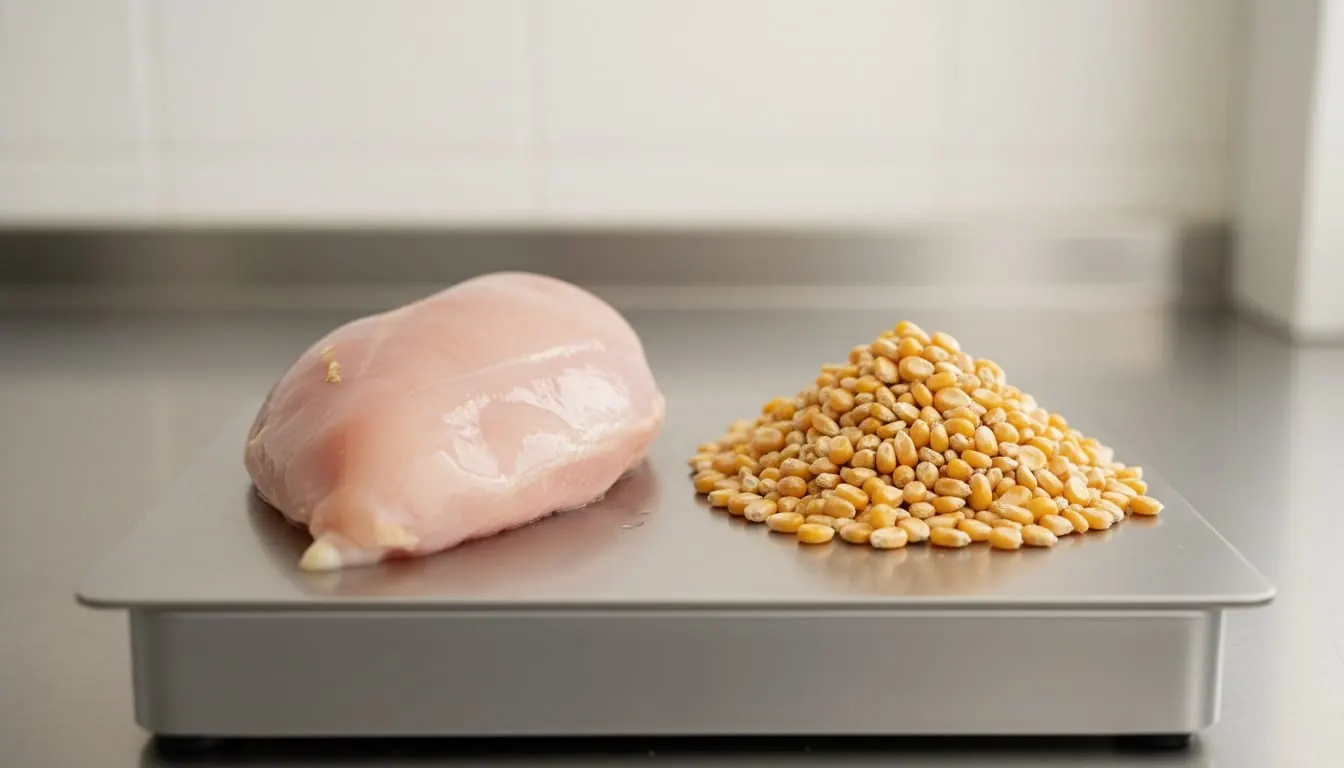
Fresh meat ranks high on labels largely because of its water content: ingredients are weighed at the time of manufacture, and fresh chicken is approximately 70% water. This is one of the most complex aspects of ingredient splitting to spot. During the 'extrusion' process—the method used to make dry kibble—that water is cooked away. However, the label still reflects the heavy, wet weight of the chicken, which naturally places it at the top of the list.
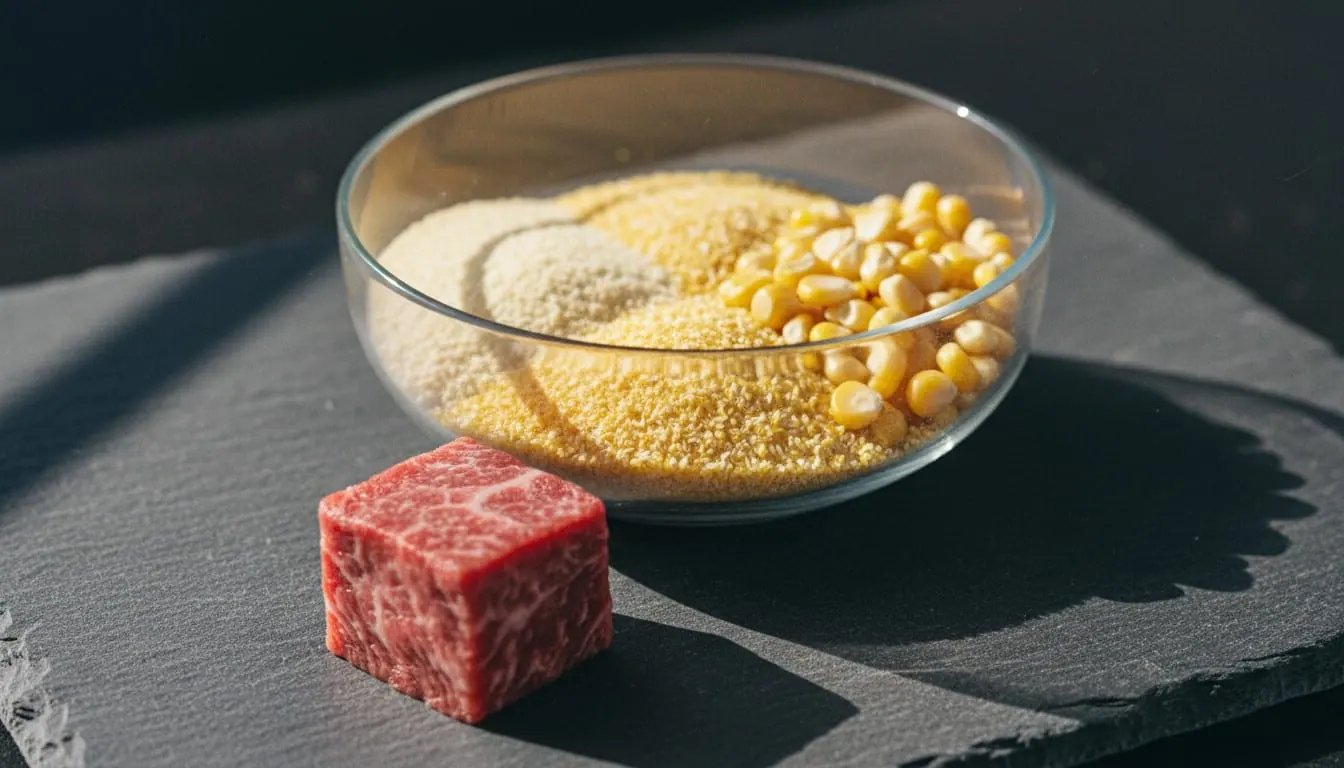
Conversely, 'meat meal' (such as chicken meal) is a concentrated protein source that has already had its moisture removed. While 'fresh chicken' might look better on a label than 'chicken meal', 1kg of meat meal actually provides significantly more protein than 1kg of fresh chicken once the water is removed. If a manufacturer uses a small amount of fresh meat and then splits the remaining carbohydrate fillers, they create a product that appears meat-dominant but is nutritionally inferior to a product using high-quality meat meals and fewer fillers.
Fresh meat weight includes water that is removed during cooking, often making it appear more prominent than it is.
Factor
Fresh meat (e.g. 'fresh chicken')
Meat meal (e.g. 'chicken meal')
Weight on the label
Weighed wet, so it ranks deceptively high.
Weighed dry, so it ranks honestly.
Water content
Around 70% water before extrusion.
Under 10% water; already dried.
Protein delivered per kilogram
Low once the moisture cooks away.
Highly concentrated animal protein.
What to check
Whether split fillers follow it on the list.
That a named species is specified, not generic 'meat meal'.
Fresh meat versus meat meal on a dry food label
Common 'Split' Ingredients in UK Pet Foods
Maize (corn) is the most frequently split ingredient in UK pet foods, followed closely by wheat, peas, and, in grain-free recipes, potatoes. When shopping at retailers like Pets at Home or the big supermarkets, watch for these appearing under several names: potatoes alone are routinely listed as 'potato starch', 'potato protein', and 'dried potato' within a single recipe.
Be particularly wary of 'Animal Derivatives'. This is a broad term that allows manufacturers to use various parts of different animals depending on what is cheapest on the market that week. When this is combined with ingredient splitting of cereals, the result is a highly processed food with very little consistency or nutritional transparency. High-quality UK brands will typically list specific meats (e.g., '60% Dehydrated Duck') and avoid splitting their carbohydrate sources, often opting for a single, whole-grain source like oats or barley if they include grains at all.
Maize, peas, and potatoes are the most commonly split ingredients in both standard and grain-free UK pet foods.
Troubleshooting: Decoding Vague Labelling
The quickest way to decode a vague label is to check whether the stated percentages add up and whether the analytical constituents match the marketing. If the percentages fall well short of 100%, or if only the meat percentage is provided, the manufacturer is likely hiding the volume of fillers. Secondly, look at the 'Analytical Constituents' section. In the UK, this must show the crude protein, fat, and fibre levels. If the protein is low (below 22% for dogs) despite meat being the first ingredient, ingredient splitting is almost certainly at play.
If your pet is showing signs of digestive upset, such as flatulence or loose stools, it may be a reaction to the high volume of split fillers like maize gluten or pea fibre. In these cases, switching to a 'fixed formula' diet—where every ingredient and its percentage is clearly defined—can often resolve the issue. If you cannot identify at least 50% of the bag's contents through specific meat and whole-food percentages, it is best to approach the product with caution.
Check analytical constituents; low protein levels often reveal the presence of hidden split fillers.
Expert Guidance: How to Choose a Better Food
The single best defence against ingredient splitting is to choose brands that practise 'Open Ingredient Labelling', listing every ingredient and its percentage clearly, without ambiguous terms. For example, '30% Dehydrated Salmon, 20% Fresh Salmon, 15% Sweet Potato' is much more trustworthy than 'Meat and Animal Derivatives (including 4% Salmon)'.
When transitioning your pet to a higher-quality food, do so gradually over 7 to 10 days to avoid stomach upset. Start by mixing 25% of the new food with 75% of the old. While premium foods often have a higher price point per bag at Tesco or specialist boutiques, they are usually more 'nutrient-dense'. This means you can often feed smaller portions to achieve the same caloric intake, making the cost per meal more comparable than it first appears. Always ensure your pet has access to fresh water, especially when moving to a more protein-rich diet.
Prioritise brands that provide specific percentages for all ingredients and transition new diets slowly.
Conclusion
Navigating the world of pet nutrition requires a critical eye and a healthy dose of scepticism regarding 'Meat First' claims. Ingredient splitting is a sophisticated marketing tool designed to appeal to our desire for high-quality protein while allowing manufacturers to use cheaper alternatives. By applying the recombination rule and looking for specific ingredient percentages, you can see through these loopholes and make informed decisions for your pet’s health.
If you are unsure about your pet’s specific nutritional needs, particularly if they have underlying health conditions like kidney issues or allergies, always consult a qualified veterinarian or a certified pet nutritionist. While labels provide a starting point, professional guidance ensures your pet’s diet is tailored to their unique life stage and activity level. Start checking your labels today—your pet will thank you for it.
Frequently asked questions
Is ingredient splitting illegal in the UK?
No, it is not illegal. Manufacturers follow the law by listing ingredients in descending order by weight, but they use the technical distinctions between different forms of the same plant, such as flour versus meal, to legally separate them on the list. It is a loophole rather than a breach of labelling rules.
Why is 'meat meal' sometimes better than fresh meat?
Meat meal is meat that has been cooked and dried, removing the water weight. Because kibble is a dry product, meat meal provides a more concentrated and honest protein measurement than fresh meat, which is roughly 70% water before extrusion. A named meal such as 'chicken meal' high on the list is often a better sign than 'fresh chicken' followed by split fillers.
How can I tell if my dog's food has too many fillers?
Look at the analytical constituents panel for crude ash and crude protein. If ash is very high (over 9%) and protein is low (under 22%), the food likely contains a high volume of split fillers and lower-quality animal by-products. Grouping repeated ingredient families like maize flour, maize gluten and maize meal will confirm the picture.
What does 'meat and animal derivatives' mean on UK pet food labels?
It is a legal category name that covers any mixture of animal parts approved for pet food, and the exact species and cuts can change from batch to batch depending on market prices. Foods using this term offer far less transparency than those naming a specific meat with a percentage, such as '26% dehydrated chicken'.
Are grain-free pet foods free from ingredient splitting?
No. Grain-free recipes frequently split legumes and tubers instead, listing peas as pea protein, pea fibre and pea flour, or potatoes as potato starch, potato protein and dried potato. The same recombination rule applies: group the family together to judge how much of the bag is actually meat.
References & Sources
This article was researched using the following sources:
Stop relying on vague bag labels. Learn how calculating resting energy requirements (RER) can prevent pet obesity and provide the exact nutrition your dog or cat needs.
Explore the science of cue selection and discrimination to improve your pet training. Learn why visual signals outperform verbal commands and how to fix muddy communication.
Discover why decompression walks are vital for your dog's mental health. Learn how olfactory stimulation reduces stress and improves behaviour more than a long run.