Dog Car Restraint Physics: Evaluating Safety Beyond Marketing
Explore the real dog car restraint physics behind crash dynamics. Learn how rotational forces and tensile strength impact your pet's safety during Canadian road trips.
When preparing for a long haul across the Trans-Canada Highway or a quick trip to Canadian Tire, most pet owners reach for a harness labelled 'crash-tested.' However, in the world of automotive engineering, that phrase can be frustratingly vague. To truly protect your dog, you must look at dog car restraint physics—the raw science of how energy moves during a collision. While marketing teams focus on aesthetics, physics focuses on the terrifying reality of kinetic energy. Understanding concepts like rotational force, tensile strength, and impact duration allows you to see past the packaging and choose gear that actually withstands the forces of a high-speed accident on an icy 401.
The Law of Inertia: Kinetic Energy at 100 km/h
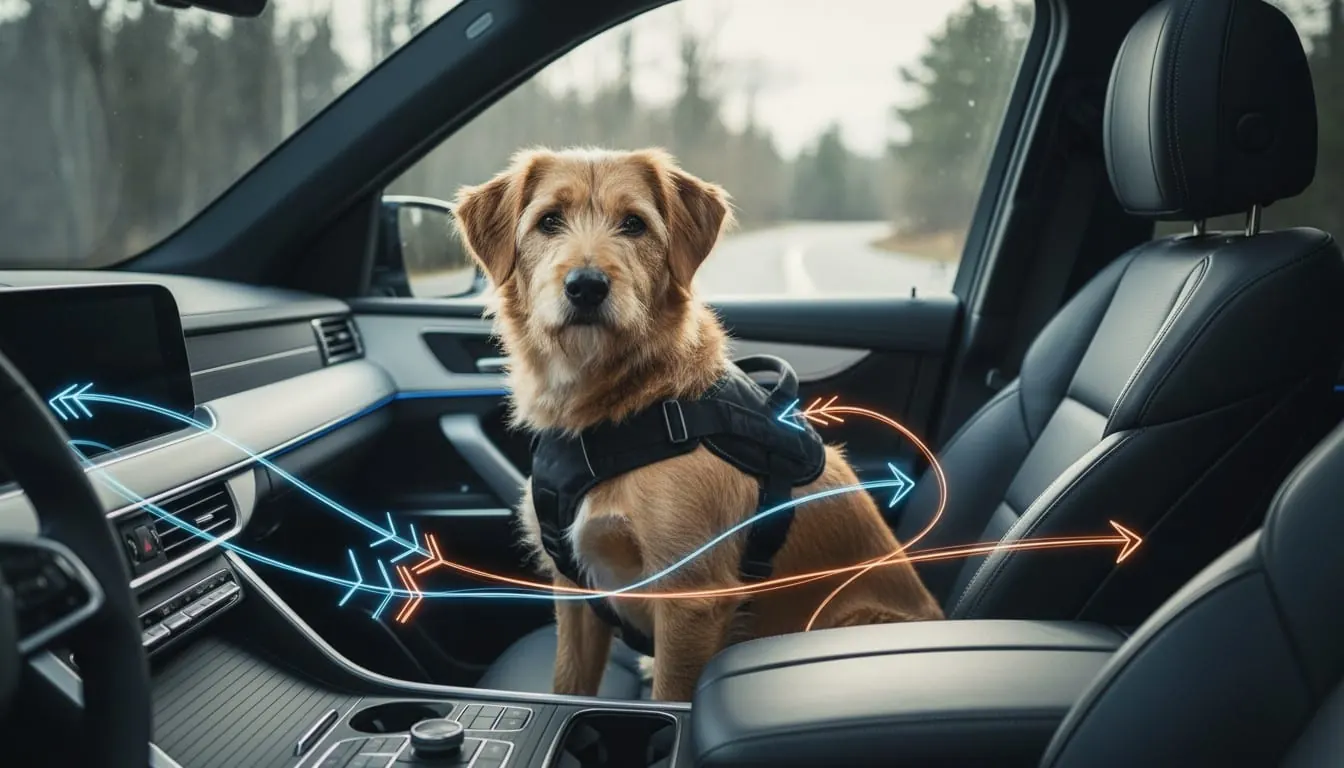
At 100 km/h, your dog is travelling at 100 km/h too, and in a sudden stop they keep moving at that speed until something physically stops them—that is Newton’s First Law of Motion at work, and it is the single most important concept in restraint safety. The restraint’s entire job is to be that something before the windshield or the back of your seat is. The force of the impact is calculated by mass times deceleration, which is why highway speed and stopping distance matter far more than anything printed on the packaging.
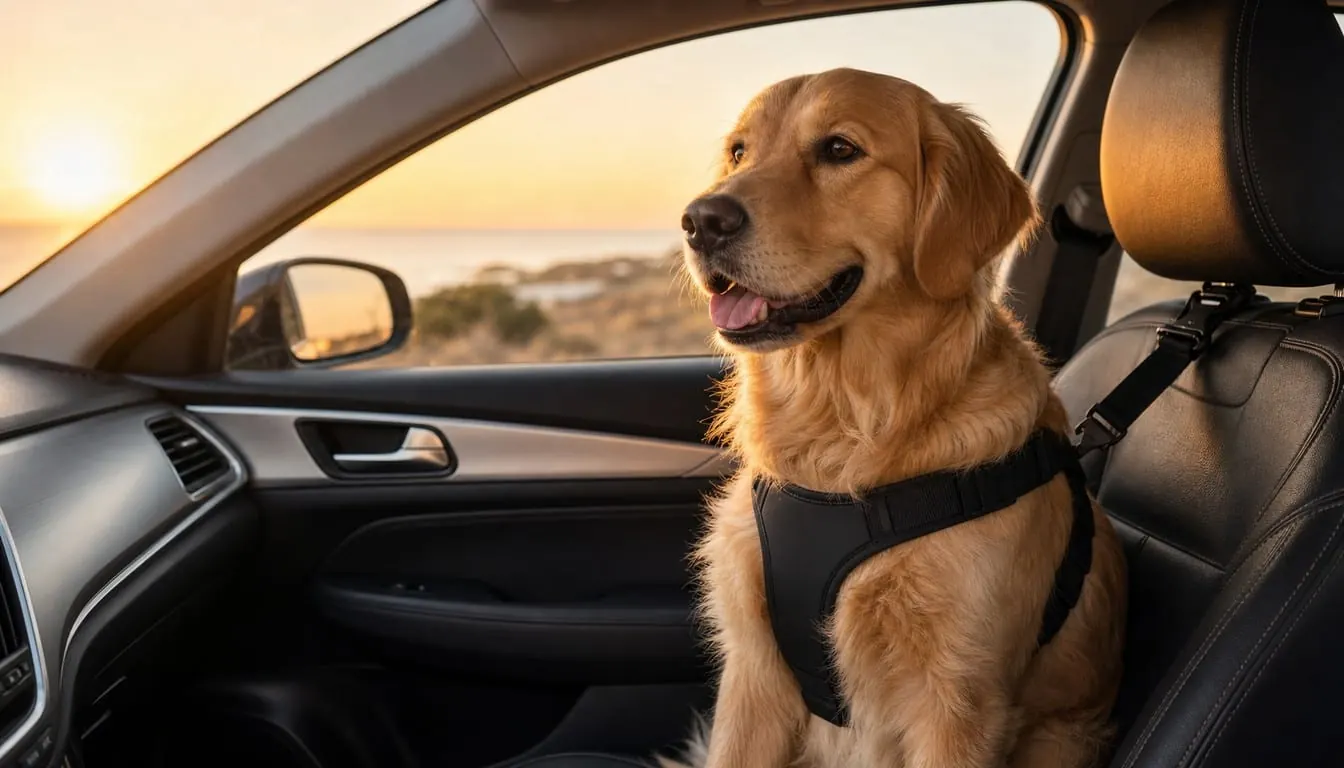
In a 50 km/h crash, a 25-kilogram dog (roughly the size of a standard Golden Retriever) becomes a 1,000-kilogram projectile. For Canadian drivers facing winter slush and unpredictable wildlife, this 'projectile force' is the primary danger. A restraint’s job isn't just to hold the dog in place; it is to manage the deceleration of that massive force without the hardware snapping. High-quality harnesses use climbing-grade webbing because it has a higher energy-absorption rate compared to the cheap nylon found at big-box retailers.
In a crash, your dog's effective weight multiplies by forty, requiring gear that can handle thousands of kilograms of force.
Tensile Strength and Hardware Failure Points
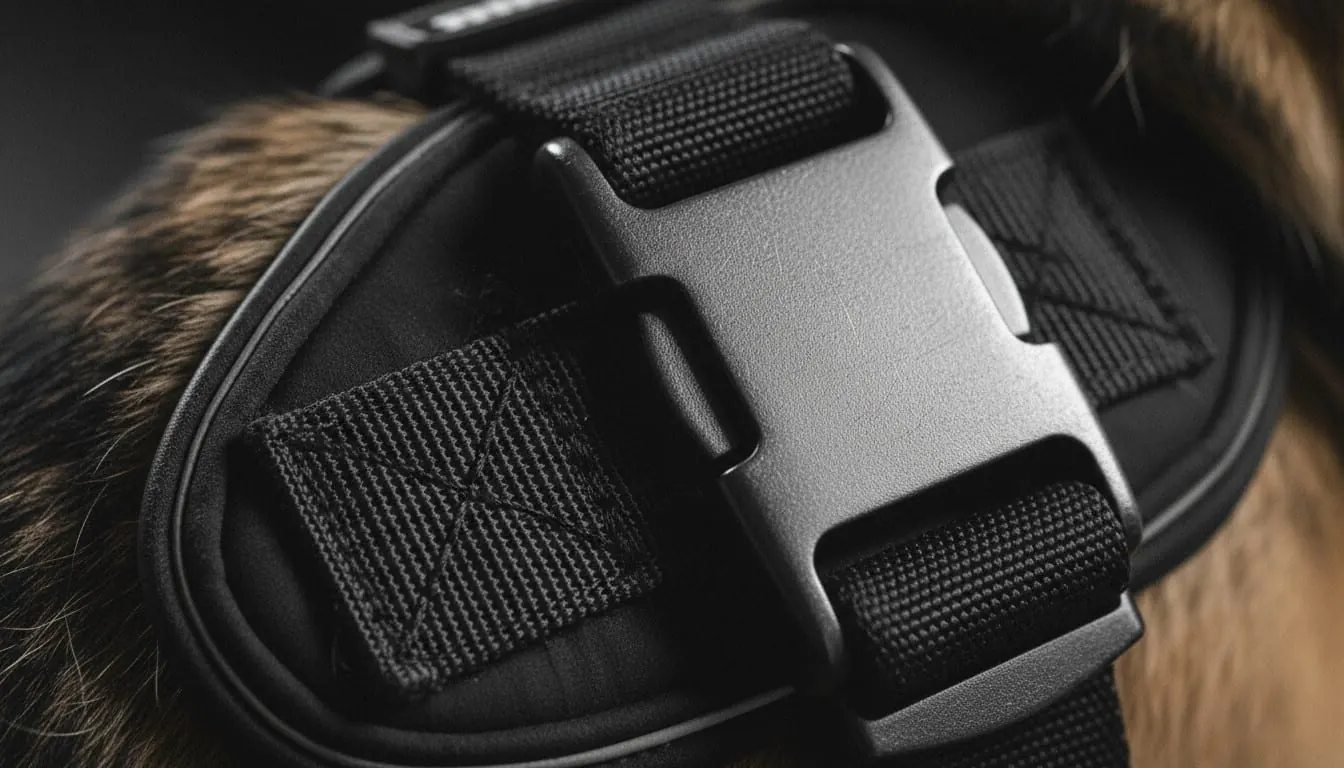
Restraint systems almost always fail at the hardware—the carabiners, D-rings, and buckles—rather than the fabric, which is why the break strength of individual components matters more than any claim printed on the box. Tensile strength refers to the maximum load a material can support without fracturing, and most 'crash-tested' marketing quotes only the webbing. In Canada, where temperatures can drop to -30°C, there is an added complication: plastic components become brittle and prone to shattering upon impact.
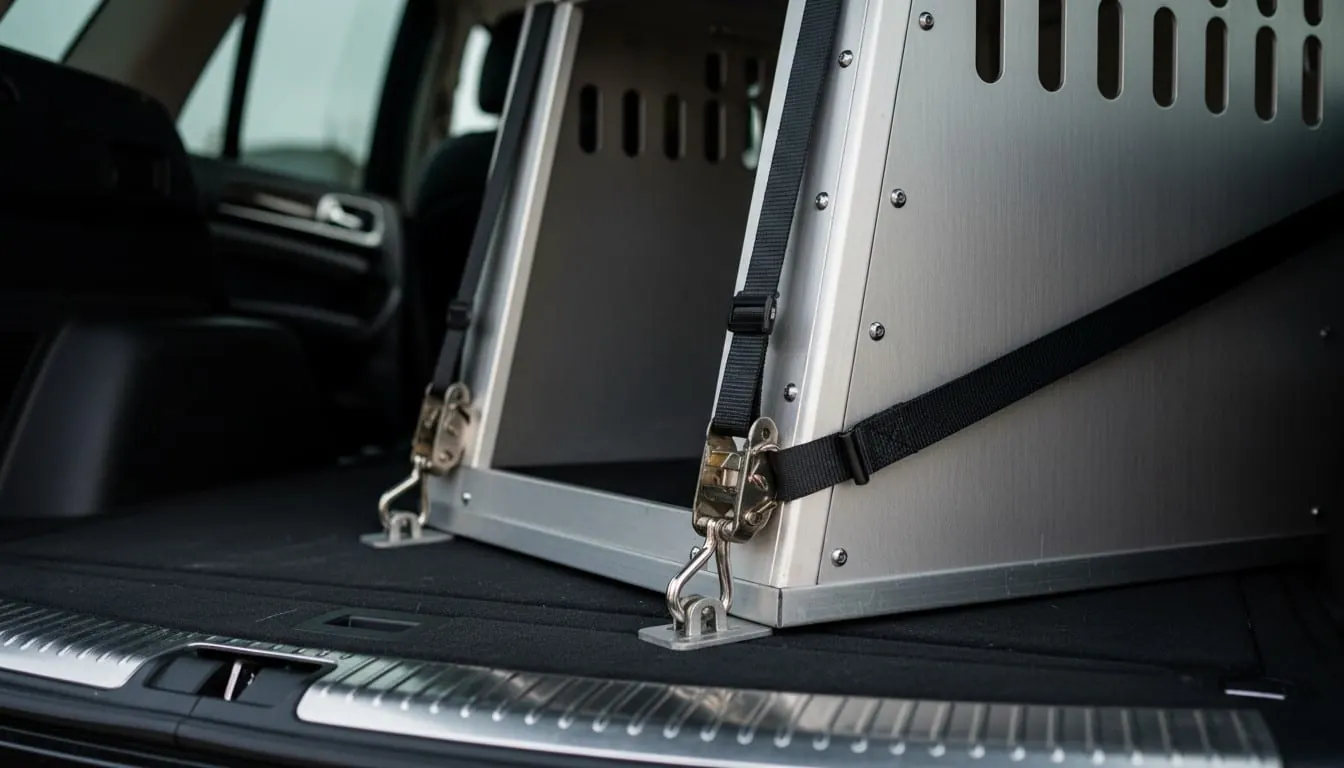
Look for 'all-metal' hardware, specifically load-bearing carabiners rated for at least 20 kilonewtons (kN). Many standard seatbelt attachments use 'zinc die-cast' clips which are cost-effective but have low shear strength. Engineering-grade restraints utilize steel or forged aluminium. When evaluating a product, ignore the 'suitable for dogs up to 30kg' label and ask for the break-strength of the individual components. A restraint is only as strong as its weakest link, which is almost always the connection point to the vehicle's ISOFIX or seatbelt system.
Hardware material
Typical break strength
Behaviour at -30°C
Verdict for car restraint
Plastic side-release buckle
Roughly 100-200 kg
Becomes brittle and can shatter
Walking use only
Zinc die-cast clip
Low shear strength, varies widely
Prone to fracture in deep cold
Avoid at load-bearing points
Steel or forged aluminium carabiner
20 kN (about 2,000 kg) or more
Retains rated strength
Best choice for crash loads
How common restraint hardware materials compare under crash loads
Prioritize forged metal hardware over plastic or cast zinc to ensure the restraint doesn't shatter in extreme cold or high-impact scenarios.
Managing Rotational Forces and Whiplash
Rotational force is best managed by a broad chest harness with a short, low-mounted tether—never by anything attached to a collar. Linear movement is only half the battle: during a collision, vehicles often rotate or spin, especially on icy Canadian roads, and this introduces rotational force (torque) to your pet’s body. If a dog is restrained by a single long tether attached to a collar, the head and neck act as a pivot point, leading to catastrophic spinal injuries or internal decapitation.
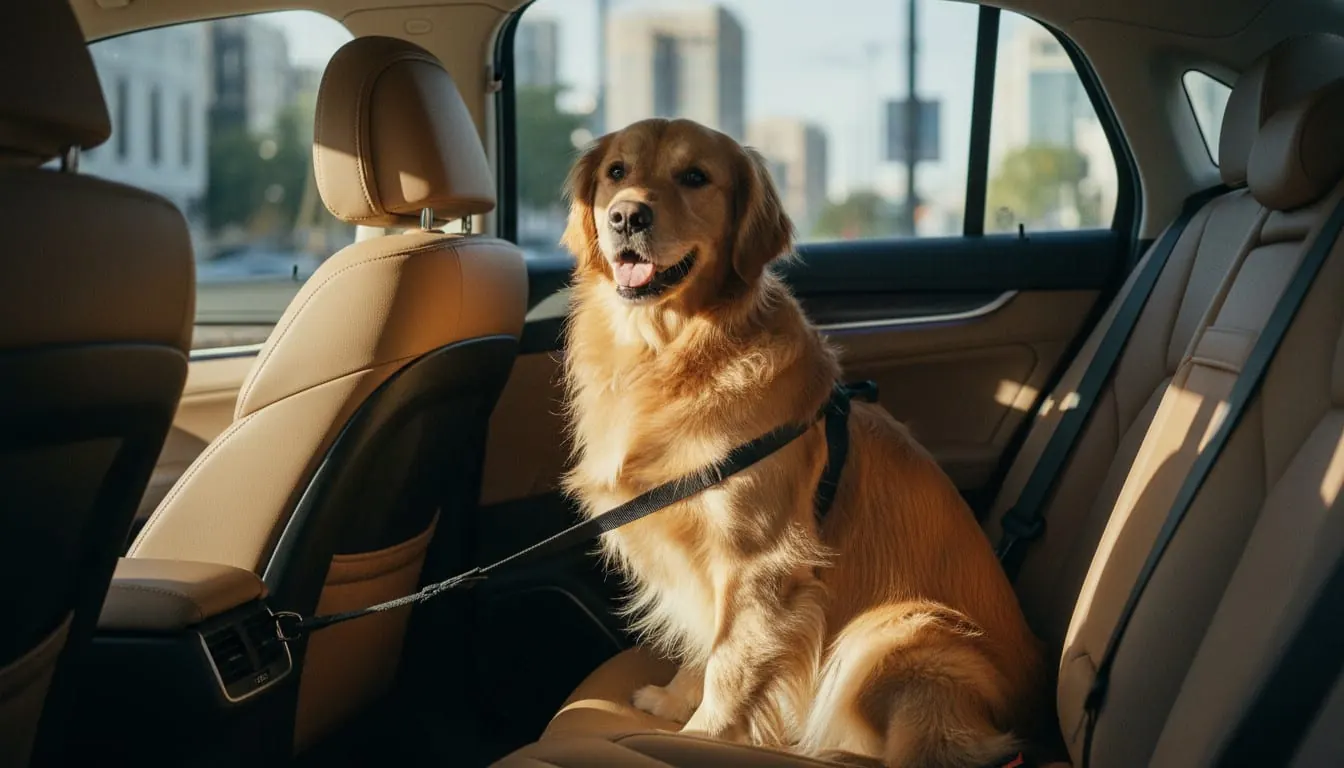
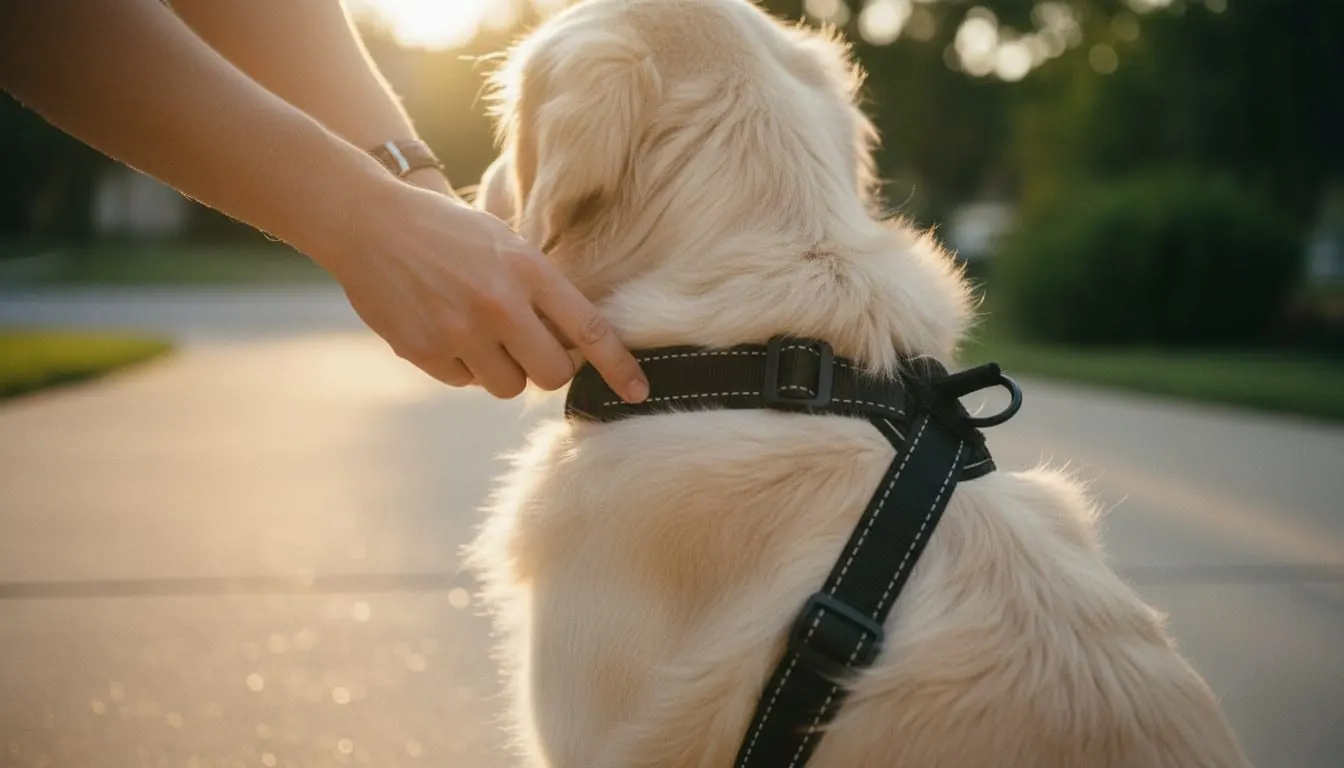
Broad-chest harnesses are designed to distribute this force across the strongest part of the dog: the ribcage. By using a dual-attachment point or a short-lead system, the restraint centres the dog's mass. This limits the 'pendulum effect' where the dog’s rear end swings forward, potentially hitting the back of the front seats. Short tethers are safer than long ones because they reduce the distance the dog can accelerate before being caught by the restraint, significantly lowering the peak force exerted on their organs.
Short, chest-mounted restraints minimize the distance your dog travels before stopping, reducing the risk of spinal 'whip' injuries.
Crumple Zones and Dynamic Energy Absorption
The safest restraints slow your dog down gradually rather than instantly, borrowing the same principle as a car's crumple zone. Just as modern vehicles deform to absorb energy, the best dog restraints incorporate 'dynamic' elements—a specialized weave in the webbing that stretches slightly under extreme load, or a harness design that allows for controlled deformation. This 'stretch' is vital; if a restraint is too rigid, the stop is so instantaneous that the internal organs can be damaged by the harness itself.
In Canada, the Center for Pet Safety (CPS) is the most cited independent body for these metrics. They look for 'excursion'—how far the dog moves from the seat. A harness that allows for a few centimetres of controlled stretch is often safer than one that is completely static, as it increases the time over which the deceleration occurs. This is the difference between catching a baseball with a stiff hand versus 'giving' with the ball as you catch it.
Look for harnesses with energy-absorbing webbing that provides a controlled stretch to soften the 'stop' during an impact.
Troubleshooting: When the Best Gear Fails
Most real-world restraint failures are fitting failures, not manufacturing defects—even the most scientifically advanced harness will fail if it is worn loose or layered over the wrong gear. Common issues include 'loose-strap syndrome,' where owners leave too much slack so the dog can move around. This slack allows the dog to gain momentum before the restraint engages, often snapping the hardware. Another issue is the 'winter coat gap.' In Canada, we often put our dogs in thick parkas. If the harness is fitted over a puffy coat, the compression of the fabric during a crash creates a massive amount of slack, allowing the dog to slip out of the harness entirely.
Always fit the harness directly against the dog's body, then put the coat over the top if possible. Check the tension regularly; you should only be able to fit two fingers between the strap and your dog's skin. If you notice any fraying on the webbing or rust on the metal buckles, the structural integrity is compromised and the gear must be replaced immediately.
Always fit harnesses snug to the dog's body, avoiding the 'winter coat gap' that can lead to harness failure during impact.
Conclusion
The safest restraint is the one whose physics you understand: a snug, broad-chest harness with rated metal hardware, a short tether, and a little engineered stretch. Navigating the world of pet safety gear requires looking beyond the glossy marketing of 'crash-tested' labels and understanding the forces that govern every road trip. By focusing on tensile strength, hardware integrity, and the reduction of rotational forces, you can make an informed decision that truly protects your canine companion, whether you are driving through the Rockies or commuting in downtown Toronto. Always prioritize gear with independent test results and perform regular checks for wear and tear. For complex setups or specific vehicle requirements, consulting with a professional dog trainer or a vehicle safety specialist is a wise next step.
Frequently asked questions
Does Transport Canada regulate dog car restraints?
No, Transport Canada does not currently have specific safety standards or regulations for pet restraints. Because of this, it is up to the consumer to evaluate products based on independent crash testing or mechanical engineering principles like component break strength.
Can I use a regular walking harness for car travel?
Most walking harnesses are designed to withstand about 100-200 kg of pull force, whereas a car crash generates over 1,000 kg. Standard plastic clips on walking harnesses will almost certainly shatter upon impact at highway speeds.
Are 'crash-tested' labels legally binding in Canada?
The term 'crash-tested' is not a protected legal term for pet products. A manufacturer can claim a product is crash-tested even if it failed the test or was only tested at low speeds. Always look for the specific test results and the speed at which the test was conducted (e.g., 48 km/h or 30 mph).
Is a crash-tested crate safer than a harness?
A properly anchored, crash-tested crate in the cargo area of an SUV or wagon performs very well, particularly for large dogs, because a rigid structure manages energy across the whole body. An unsecured crate, however, becomes a projectile itself. Whichever you choose, the anchoring method matters as much as the product.
References & Sources
This article was researched using the following sources:
Master cue selection and discrimination to build a clear training language. Learn why pets process visual signals faster and how to choose distinct verbal commands.
Unlock the benefits of decompression walks for your dog. Learn why olfactory stimulation is more effective than physical distance for mental health and stress reduction.