For years, pet owners have been told that the single most important factor in choosing a high-quality kibble is ensuring a named meat is the first item on the bag. This 'meat first' mantra has become the gold standard for savvy shoppers at retailers like Target or Amazon. However, many manufacturers have found a clever loophole to satisfy this demand without actually increasing the meat content of the food. This practice, known as ingredient splitting, breaks a single inferior filler into several smaller components so that each one drops lower on the weight-ordered ingredient list, quietly floating a named meat to the top. Learning to spot it is the difference between paying for protein and paying for clever labeling.
The Physics of the Pet Food Label
The pet food label follows one simple physical rule that manufacturers exploit: ingredients are listed in descending order by their weight at the moment the recipe is mixed, not after it is cooked. In the United States, the Food and Drug Administration (FDA) and the Association of American Feed Control Officials (AAFCO) require this descending-by-weight order, and that weight is measured at the time of formulation—which means the ingredients are weighed *before* they are processed, cooked, or dried into kibble.
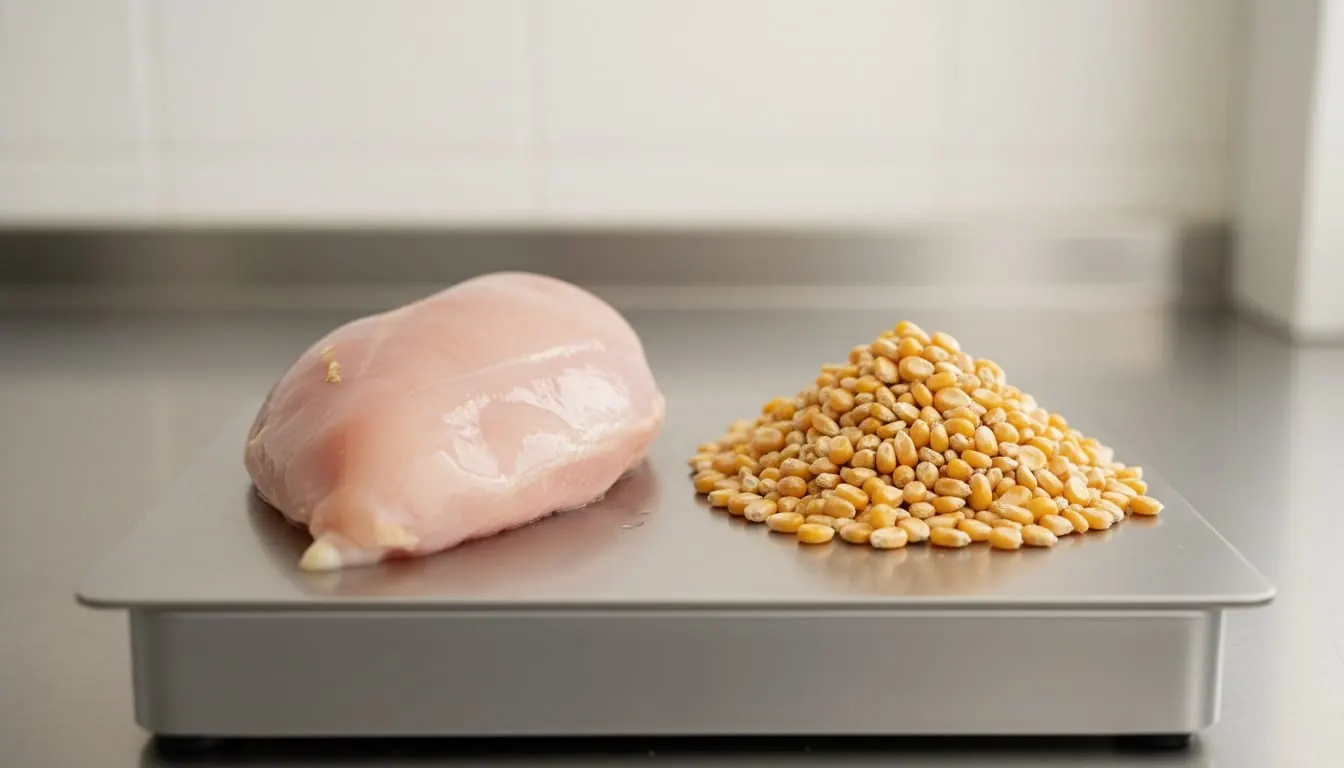
This 'pre-cooking weight' is the foundation of the 'Meat First' myth. Raw meat, such as chicken or beef, is roughly 70% water. When a manufacturer weighs raw chicken, that heavy water content naturally pushes it to the top of the list. However, once the food is extruded and dried, that water is gone. The actual protein content left behind may be significantly less than the dry grains or legumes further down the list. Manufacturers rely on the fact that US consumers rarely look past the first two or three items, assuming that 'Chicken' at number one means the bag is mostly meat.
Ingredients are listed by their pre-cooked weight, allowing water-heavy meats to artificially claim the top spot over drier, denser fillers.
Understanding the Mechanics of Ingredient Splitting
Ingredient splitting is the tactical practice of taking a single, less-desirable ingredient and dividing it into several different sub-categories. Because each sub-category now weighs less than the original whole ingredient, they all drop lower on the list, effectively 'clearing the way' for meat to appear first. It is a legal but highly effective way to create a 'health halo' around a product that is actually high in carbohydrates.
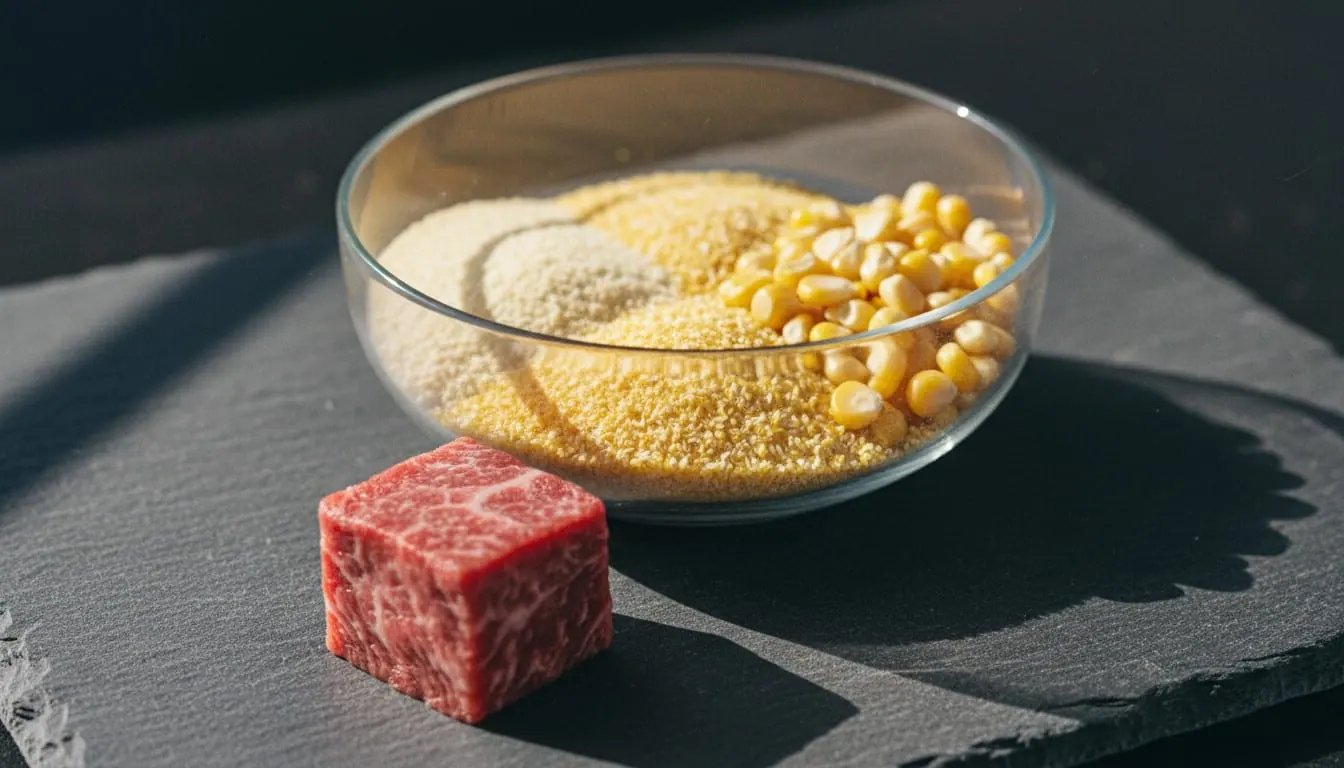
Imagine a bag of dog food that contains 20 pounds of corn and 15 pounds of chicken. Legally, corn should be the first ingredient. However, if the manufacturer 'splits' that corn into 7 pounds of ground corn, 7 pounds of corn gluten meal, and 6 pounds of corn flour, suddenly none of the corn components weigh more than the 15 pounds of chicken. Like magic, the label now lists 'Chicken' as the first ingredient, followed by the three corn components. The recipe hasn't changed at all—it is still a corn-heavy food—but the label tells a much more 'premium' story to the unsuspecting shopper.
Ingredient splitting divides one large ingredient into smaller parts to push more attractive ingredients to the top of the label.
Common 'Splitters' to Watch For in the Pet Food Aisle
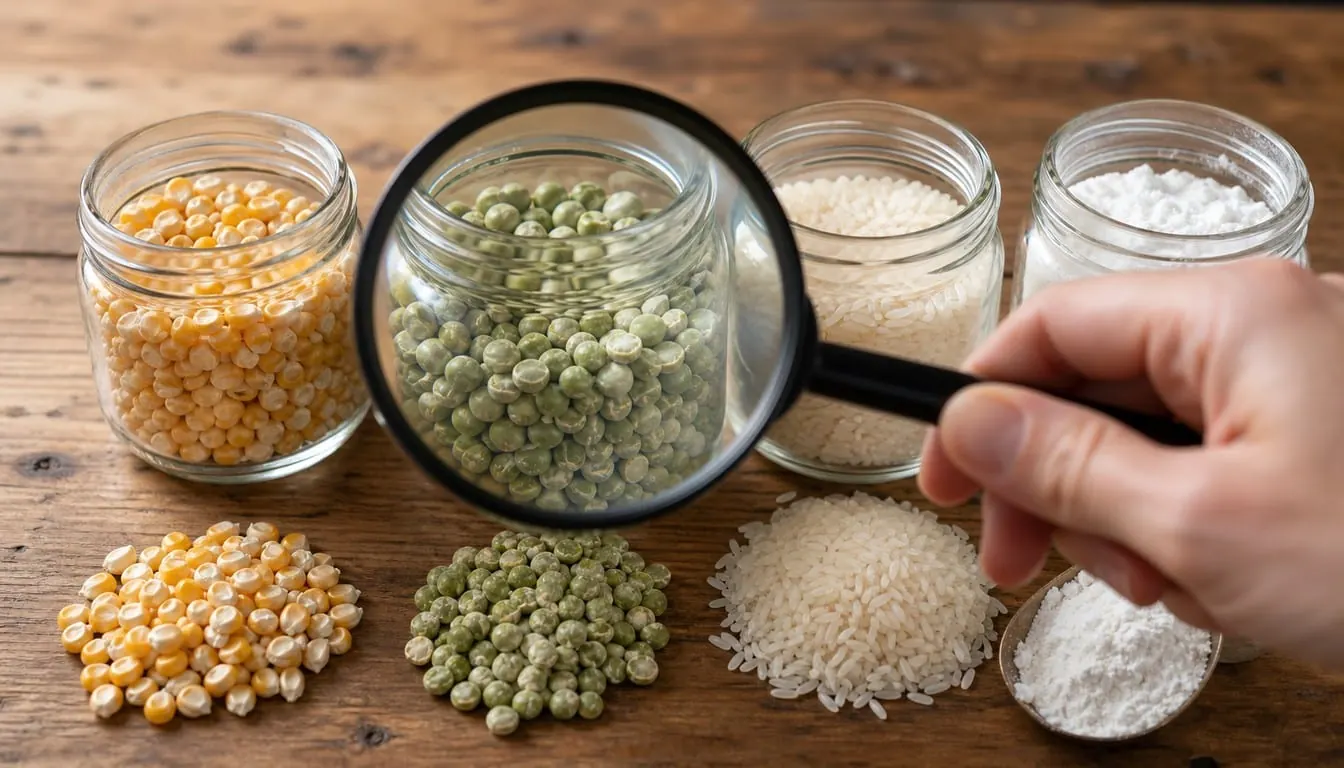
The ingredients most often split are cheap bulk starches, grains, and legumes—corn, rice, peas, and potatoes—because they are the inexpensive calories a brand would rather not advertise as the base of its recipe. When browsing the shelves at a local pet store or Costco, watch for clusters of the same base food wearing different names. For grains, look for 'Whole Grain Corn,' 'Corn Meal,' 'Corn Gluten Meal,' and 'Corn Bran' grouped together; for rice-based foods, you might see 'White Rice,' 'Brown Rice,' 'Rice Flour,' and 'Rice Bran' all appearing in the same first five to seven ingredients.
Potato, Potato Starch, Dried Potato, Potato Protein
One starchy tuber split several ways
Common split ingredients and the label names they hide behind
In the era of grain-free diets, peas and potatoes have become the new favorite targets for splitting. Manufacturers frequently divide these into 'Peas,' 'Pea Fiber,' 'Pea Flour,' and 'Pea Protein.' If you see three or more of these variations near the top of the list, the food is likely 'pea-heavy' rather than 'meat-heavy.' This is particularly important because high concentrations of legumes have been a point of study regarding their impact on canine heart health. By splitting the peas, the manufacturer can hide just how much of the diet is comprised of these plant-based fillers.
Watch for multiple variations of corn, rice, peas, and potatoes appearing together in the top ten ingredients.
The Mental Recombination Technique
The mental recombination technique is simple: as you read the label, add every variation of the same base ingredient back together into one entry, then re-rank the list in your head. If you see 'Chicken' followed by 'Pea Flour,' 'Dried Peas,' and 'Pea Protein,' combine those three pea ingredients into a single large 'Peas' category and ask whether that combined weight would now outrank the chicken. In almost every case where three variations of the same starch appear in the top five, that starch—not the meat—is the true primary ingredient in the bag.
Another expert trick is the 'Salt Bridge.' As a common rule of thumb, salt usually makes up only about 1% of a complete diet, so anything listed after salt is present in very small, likely negligible amounts. However, ingredient splitting usually happens at the very top of the list. If you find multiple versions of a single grain occurring *before* the fat source (like 'Chicken Fat'), you can be certain those grains are the dominant caloric drivers of the food. Don't be fooled by the variety; those four different names for corn are all doing the same job: providing cheap calories while keeping the meat in the number one spot.
Mentally group all variations of the same starch together to determine if it actually outweighs the primary meat source.
Troubleshooting: When the Label Still Looks Good
If you have recombined the split ingredients and the label still looks meat-heavy, check whether that meat is fresh or 'meal,' because that single distinction can flip the food's real protein ranking. Manufacturers sometimes list 'Meat Meal' (like Chicken Meal) instead of 'Fresh Meat,' and while 'meal' sounds less appetizing, it is a concentrated protein source whose water has already been removed. A label with 'Chicken Meal' as the second ingredient can actually contain more real protein than one with 'Fresh Chicken' as the first ingredient, because the fresh chicken was roughly 70% water when it was weighed.
If your pet is struggling with digestive issues, itchy skin, or low energy despite a 'premium' label, it may be time to look closer at the nutritional adequacy statement. If the food is heavily split and relies on plant proteins like 'Pea Protein' or 'Corn Gluten Meal' to meet its protein percentage goals, your pet may not be getting the full profile of essential amino acids they would get from animal-based sources. Signs that you should adjust your approach include lackluster coat quality, excessive stool volume, or a sudden disinterest in the food. If these issues persist, consulting a board-certified veterinary nutritionist is the best next step to ensure your pet's specific needs are being met.
High stool volume or poor coat quality can indicate a food is relying on poorly-digested plant fillers disguised by ingredient splitting.
Navigating the Marketing Maze: Final Advice
To navigate the marketing maze, stop judging a food by its first ingredient and read the first five to ten as a single group. A truly high-quality, meat-focused food will typically list a named meat or meat meal followed by one or two distinct carbohydrates, rather than a long list of fragmented starches. Look for transparency, too: brands that are proud of their ingredients often publish detailed percentage breakdowns on their websites instead of relying on label order alone.
Remember that 'Grain-Free' does not mean 'Carbohydrate-Free.' Many grain-free brands at stores like Walmart or on Amazon are the worst offenders of pea and potato splitting. Always look for the 'Complete and Balanced' statement, and don't be afraid to reach out to the manufacturer directly. Ask them: 'If I combined all the pea components in this recipe, would they weigh more than the chicken?' A reputable company should be willing to provide clarity on their formulation. Your pet depends on you to look past the front of the bag and understand the reality of what is inside.
Look at the first ten ingredients as a group rather than fixating on the first one, and don't confuse grain-free with low-carb.
Conclusion
Cracking the code of ingredient splitting is one of the most powerful skills a pet owner can develop. While the 'Meat First' claim is a powerful marketing tool, it is often a carefully constructed illusion supported by fragmented fillers and water weight. By learning to mentally recombine split ingredients and looking at the first ten items on the label as a holistic group, you can ensure your hard-earned money is going toward high-quality nutrition rather than clever labeling tactics. Always monitor your pet’s physical condition and consult with a veterinarian if you have concerns about their dietary needs. Your pet's health is built from the inside out, and it starts with what actually fills the bag.
Frequently asked questions
Is ingredient splitting legal in pet food?
Yes, ingredient splitting is entirely legal. Manufacturers still follow the rule that ingredients be listed by their common name in descending order by weight; they simply list the fragmented parts of an ingredient rather than the whole. Nothing on the label is technically false, which is why the practice is so effective.
How can I tell if meat is actually the main ingredient in dog food?
Look for a named meat meal, such as Chicken Meal or Beef Meal, at or near the top of the list, because meal has already had its water removed and represents concentrated protein. If a fresh meat is listed first but followed by three or more variations of a single grain or legume, that plant filler is likely the true main ingredient once you add its parts back together.
Is chicken meal worse than fresh chicken in dog food?
No, chicken meal is not inherently worse than fresh chicken, and it can mean more protein rather than less. Fresh chicken is roughly 70% water when it is weighed for the ingredient list, while chicken meal is under 10% moisture, so a food listing chicken meal second may contain more actual chicken than one listing fresh chicken first.
Does grain-free dog food avoid ingredient splitting?
No, grain-free foods are often among the heaviest users of ingredient splitting, dividing peas and potatoes into components like pea flour, pea protein, pea fiber, and potato starch. The FDA has investigated a potential link between grain-free diets high in peas, lentils, and potatoes and cases of canine dilated cardiomyopathy, so recombining those split legumes matters for more than marketing.
Is ingredient splitting dangerous for my pet?
Ingredient splitting is not necessarily dangerous, but it can be misleading about a food's real nutritional value. It often means the food is higher in carbohydrates and lower in animal-based protein than the front of the bag suggests. If your pet shows dull coat quality, high stool volume, or low energy on a heavily split food, it is worth reviewing the recipe with your veterinarian.
References & Sources
This article was researched using the following sources:
Stop guessing with vague feeding charts. Learn the veterinary math for calculating resting energy requirements to ensure your pet stays lean and healthy.
Discover why decompression walks are the ultimate mental health tool for your dog. Learn the biology of sniffing and how to prioritize scent over physical distance.